Hydrogen import strategy - strategic challenges in the transport sector
Sufficient transport capacities are essential for the rapid development of a hydrogen market.
This article is the third part of a four-part series of articles to mark the publication of the former German Federal Government's hydrogen import strategy in July 2024 and deals with the current challenges associated with the transport of hydrogen and the development of a hydrogen core network in Germany. The preceding articles to this series highlighted the ramp-up and import requirements as well as potential countries of origin of hydrogen imports.
The challenges of transporting hydrogen
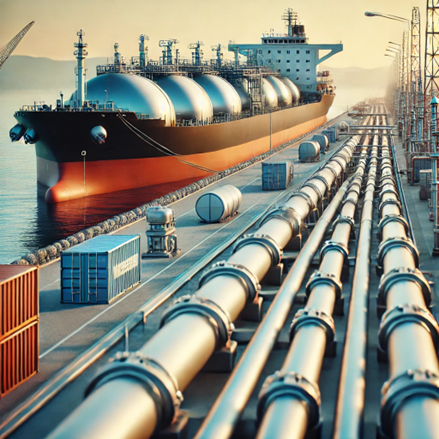
As a colourless and odourless gas, hydrogen can be transported via pipelines in the most environmentally friendly and cost-efficient way. However, the expansion of an offshore pipeline structure is cost- and resource-intensive. Thus, at the same time, the infrastructure for ship transport must be further expanded to enable the import of green hydrogen to Europe and Germany.
Transport as a logistical challenge
At normal air pressure and temperatures, hydrogen has a very large volume. This makes the transport of gaseous hydrogen by ship technically difficult. Thus, carrier media or hydrogen derivatives are used because they have different chemical-physical properties. The most important hydrogen derivatives are ammonia, methanol and Fischer-Tropsch products
Transport as a regulatory challenge
In addition to the logistical challenges, there is also a regulatory challenge: As required by EU law, hydrogen may only be labelled as “green” in Germany (and all other EU Member States) if it achieves greenhouse gas savings of 70% over its entire life cycle compared to the fossil comparison value of 94 gCO2 eq/MJ. Only under these circumstances can it be assumed that hydrogen contributes to achieving climate protection goals. Emissions generated during the transport of hydrogen also count as life cycle emissions. Accordingly, hydrogen importers must always bear in mind the emissions intensity of the respective transport modality when designing their specific import route.
Landing of hydrogen derivatives
The terminal infrastructure must be expanded so that hydrogen derivatives can also be landed in Germany. To this end, LNG terminals are already being designed in such a way that – after being used for LNG – they can receive hydrogen derivatives, in particular ammonia, and – if necessary – convert them back into hydrogen (so-called cracking). This is intended to promote a cost-efficient transformation of the energy infrastructure and increase the profitability of necessary investment decisions. However, large ammonia storage and cracking capacities will only be created in the 2040s – after LNG imports have been phased out. Mobile ship-based import terminals are also being considered. The BMWE and the BMV have been developing a "National Climate-Friendly Shipping Action Plan" since spring 2024. This Action Plan will also focus on the green shipping corridors for the transport of green hydrogen.
Development of a hydrogen core network
As a first step, a hydrogen core network is to be created for transport within Germany. This is to be connected to the trans-European hydrogen network from the outset.
The trans-European hydrogen network envisages four corridors for transporting hydrogen through Europe via pipelines, which can be used to import hydrogen to Germany:
- In Germany's North Sea region, the new Federal Government wants to leverage the generation potential for the simultaneous production of electricity and hydrogen. The BMWE plans to present an offshore cooperation strategy for this by the North Sea Summit in 2025.
- In the Baltic Sea region, an offshore pipeline from Finland through the Baltic Sea and an onshore pipeline from the Baltic via Poland are to be built.
- The high solar and wind energy potential of the Iberian Peninsula is to be utilised via the south-west corridor.
- Green hydrogen from Algeria and Tunisia is to find its way to Europe and Germany via the southern corridor, mainly through redirected natural gas pipelines.
To increase the integration of the German core grid into the trans-European hydrogen grid, interconnectors are planned at the border crossing points to connect the German grid with the grids of neighbouring countries. Storage options are also planned as part of the core network planning in order to compensate for fluctuating production and import volumes. The BMWE published its “White Paper Hydrogen Storage” in April 2025. The paper specifies storage needs and potentials and can be used by the new Federal Government as a guideline.
Planning the hydrogen core network
For the German hydrogen core network with an initial total length of around 9,040 kilometres, 60% of the existing gas infrastructure pipeline network will be used. The remaining 40% will be newly built. The hydrogen pipelines will be operated by the existing gas transmission system operators. In the north-west, the core network is planned to be more closely meshed, as more electrolyser projects and import points are to be built there. However, the new Federal Government is also particularly concerned about connecting industrial centers in southern and eastern Germany to the hydrogen network. This year, the first pipelines of the core network were already transitioned to hydrogen. In addition, hydrogen core network system operations received the first payment from the amortization fund in March 2025.The expansion of the core network should be completed by 2032. In a second step, the existing network will then be further developed in line with demand as part of the integrated network development planning for gas and hydrogen.
The planning responsibility for the hydrogen core network lies with the transmission system operators, who should submit a joint application to the Federal Network Agency for approval. The submission deadline originally ended on 29 December 2023 but was extended several times as the required state aid approval from the EU Commission was not received in time. This had to be received at least one week before the application deadline and was only granted on 21 June 2024. As a result, the application was not submitted until 22 July 2024.
Authorisation of the hydrogen core network
The approval of the joint application of the long-distance network operators by the Federal Network Agency was delayed due to a request for changes as part of the consultation process. The relevant change request appears to relate in particular to the plans in north-east Germany. The southern federal states would also like to see stronger connections to their business and industrial locations. This is also in line with the new Federal Government’s goals.
The Federal Network Agency approved the application at the end of October 2024. The approval was granted exclusively in the public interest. In the approval procedure, it was examined whether the application meets the objective of establishing a efficient, quickly realisable, expandable and climate-friendly hydrogen core network across all of Germany, whether it will enable the planned completion by 2032 and whether it will create further added value as required by law.
Unless otherwise stated in future grid development plans and if they are put into operation by 2030, the approved projects are deemed to be necessary for the energy industry, a priority and in the overriding public interest. This simplifies the subsequent planning and authorisation procedures for the specific line routes and plant locations. The respective authorities of the federal states are responsible for these procedures.
Conclusion
The new Federal Government has ambitious plans in the field of hydrogen transport. A quickly and safely functioning transport network is a fundamental prerequisite for the desired market ramp-up and the willingness of industry to transform - both in Germany and across Europe. Legal and technical challenges must be overcome on a regular basis.
We will keep informed about further developments of the hydrogen strategy and possible projects.
The EU/COMP team at CHATHAM PARTNERS specialises in complex issues and procedures relating to hydrogen projects and is happy to advise you on their planning and implementation, in particular in connection with procurement and planning procedures as well as funding opportunities.
We would like to thank Flora Bantelmann, Louica Unger and Christoph Ludwig for their valuable support in preparing this article.
DALL-E generated picture