A new direction for the energy transition in heating: a change of course with risks under Eu-ropean law?
Assessment of the coalition government's Key Issues Paper on the Building Modernization Act under European law
On February 24, 2026, the CDU/CSU and SPD coalition presented a Key Issues Paper for the new Building Modernization Act, which is intended to revise the regulations governing heat supply in Germany. The aim is to achieve greater “technological openness” and freedom of choice for property owners. However, the paper raises several questions relating to EU law, which are examined in more detail below.
Main contents of the Key Issues Paper
Since 2024, newly installed heating systems must be powered by at least 65% renewable energy, and existing oil and gas heating systems must be replaced within a transition period. These requirements are to be abolished in the future by the complete deletion of Sections 71-71p and 72 of the German Building Energy Act (Gebäudeenergiegesetz, GEG).
Instead, owners will be free to decide which heating system they use. Oil and gas heating systems may be installed again but must use an increasing share of CO2-neutral fuels (“bio-staircase”). This is to start at 10% in 2029 and increase in subsequent years. At the same time, distributors of natural gas and heating oil will be required to add climate-friendly gases and oils (e.g., biomethane, hydrogen, synthetic methane, bio-oil). This quota will initially be up to 1% in 2028, be achievable in terms of a “book and claim”-system, and be creditable toward the “bio-staircase.” Experts and commentators have criticized the use of climate-friendly gases for heating purposes given their scarcity and the urgent need for such gases in other hard-to-abate sectors.
The Key Issues Paper raises a number of legal concerns. In this regard, a key limitation for the German legislature arises from EU law and, in particular, the Energy Performance of Buildings Directive (EPBD), which was amended in 2024.
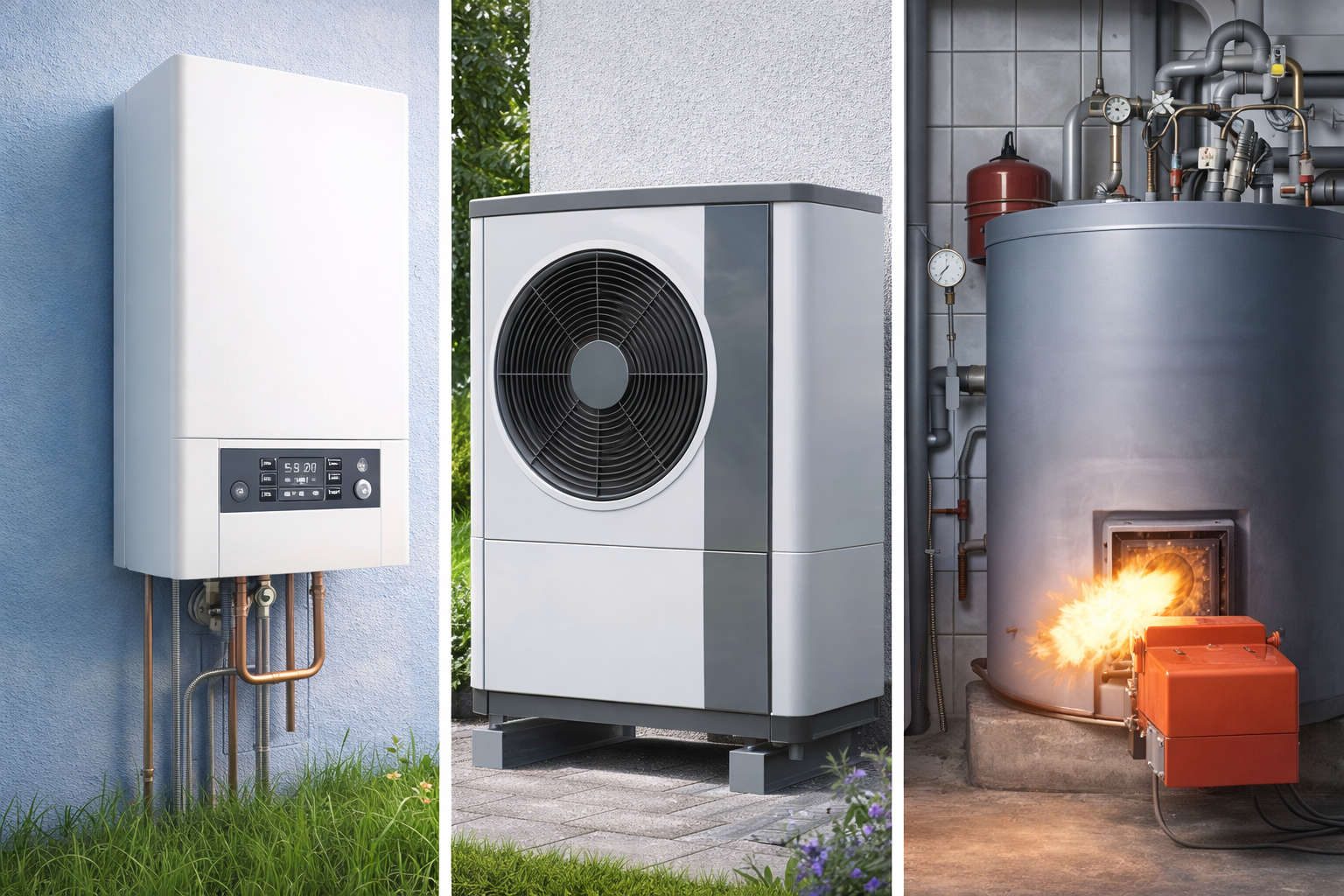
Dall-E generated image
Zero-emission buildings and decarbonization by 2050
The EPBD imposes the following obligations on Member States:
- From 2030, all new buildings must be “zero-emission buildings” in accordance with Art. 7 (1) (b) EPBD, i.e., they must not generate any CO₂ emissions from fossil fuels on site.
- Member States must develop plans to ensure that the entire building stock is highly decarbonized by 2050 in accordance with Art. 3 (1) EPBD.
According to the Key Issues Paper, the new law is intended to fully implement the EPBD (“1:1”). It however only mentions the 2030 target for new buildings and not the 2050 target for the entire building stock. While the EPBD grants Member States discretion in choosing the means of achieving the goals set out, the obligation itself to develop and implement a credible decarbonization pathway for the building stock by 2050 is binding.
A return to the unrestricted use of fossil fuel heating systems – even with blending quotas – seems to conflict with the goal of a virtually emission-free building stock.
Necessity of phasing out fossil fuel boilers
The deletion of Section 72 GEG, which obliges building owners to replace oil and gas heating systems in the future, could also be inconsistent with the EPBD. According to Art. 13 (7) EPBD, Member States should strive for the replacement of stand-alone fossil fuel-fired boilers. Annex II to the EPBD envisions that the complete phase-out should take place by 2040. It is controversial whether this target is binding. The European Commission does not consider this to be a rigid deadline. However, even if the 2040 goal is not considered strictly binding, the European Commission believes that Member States are still required to align their policies with this target.
RED III: Minimum shares of renewable energies in the building sector
The planned deletion of the 65% quota for renewable energies is particularly critical in view of the targets set by the Renewable Energy Directive (RED III). According to Art. 15a (3) subparagraph 2 sentence 1 RED III, Member States must set minimal targets for the use of renewable energy in new buildings and existing buildings undergoing major renovation or replacement of the heating system where that is economically, technically and functionally feasible. The previous 65% quota set out in the GEG met this requirement. The Key Issues Paper, however, no longer provides for such a general minimum value.
Depending on how the blending quotas develop, Germany’s compliance with its obligation to increase the share of renewable energies in its building stock seems doubtful (Art. 15a (3) subparagraph 1 RED III). In addition, the EU's climate targets must also be taken into account, which stipulate an indicative target of 49% renewable energy in the building sector by 2030 (Art. 15a (1) RED III). Reducing the blending quotas to a minimum while abandoning structural transformation instruments could undermine the purpose of the directive.
Conclusion
The coalition has announced that it will advocate for adjustments to the EPBD and longer implementation periods at the EU level. This indicates that the coalition is aware that their implementation concept does not meet the relevant EU criteria. Until an eventual change of the EPBD and RED III, their goals remain binding for Germany and all other Member States.
Whether the planned Building Modernization Act can be designed in compliance with European law remains to be seen. Even if the European Commission grants Member States broad discretion in implementing a directive, the goals set out in the Key Issues Paper require a reform of the European requirements. In any event, the key elements outlined so far for the Building Modernization Act give rise to significant doubts as to the compatibility of the governing coalition’s plans with EU law. Finally, it also appears doubtful whether the planned Building Modernization Act will be sufficient for Germany to achieve its climate targets in the building sector. Accordingly, the Key Issues Paper provides for an evaluation clause for the year 2030, which could trigger substantial adjustments to the legal framework within just a few years.
We would like to thank Constanze von Breunig and Tammo Eilts for their valuable support in preparing this article.
Dall-E generated image